Physical Therapist Hazlet NJ
Pain can make you instinctively want to move less. But when an injury, weakness, stiffness, or limited mobility is contributing to the problem, avoiding movement for too long may make returning to normal activities more difficult.
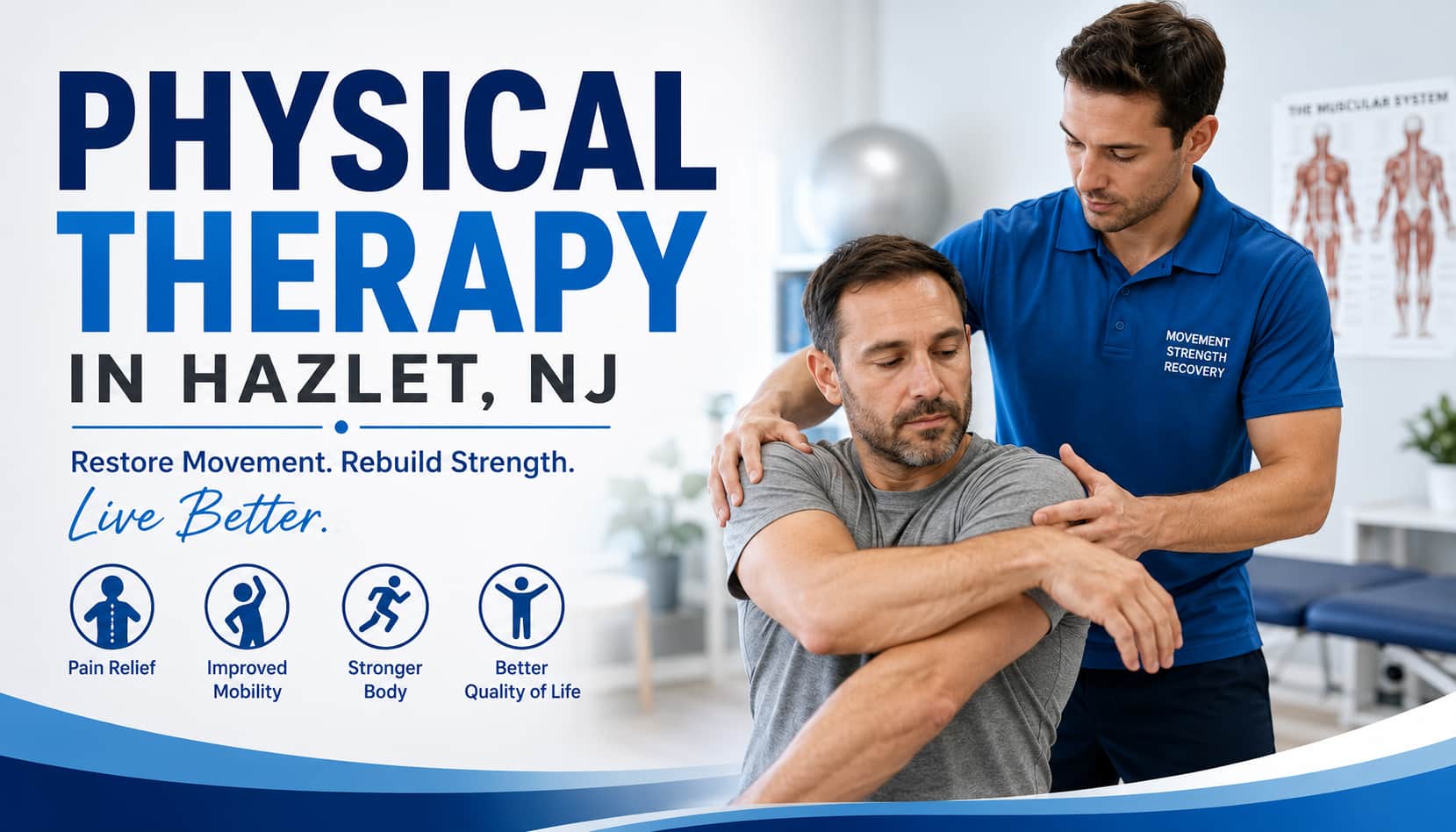
Physical therapy in Hazlet, NJ can help patients recover movement, strength, flexibility, and function following injuries, surgery, or musculoskeletal problems. The National Institute of Neurological Disorders and Stroke (NINDS) provides educational resources related to rehabilitation and recovery, supporting the importance of addressing physical limitations as part of an appropriate recovery strategy.
Rather than focusing exclusively on temporary symptom relief, a personalized rehabilitation program can address physical limitations that may be contributing to pain and difficulty with everyday activities.
At Airport Plaza Spine & Wellness in Hazlet, NJ, physical therapy can be incorporated into a multidisciplinary treatment plan based on the patient’s condition, functional limitations, and recovery goals.
What Does Physical Therapy Actually Do?
Physical therapy is much more than stretching, massage, or performing exercises during an appointment.
A physical therapy program begins by evaluating how your body is functioning.
For example, two patients may both complain of knee pain. One could have significant weakness following surgery, while another may have mobility limitations after a sports injury.
Their symptoms may sound similar, but their rehabilitation needs can be very different.
A physical therapy evaluation may examine:
- Range of motion
- Muscle strength
- Flexibility
- Balance
- Walking and movement patterns
- Joint mobility
- Functional limitations
- Activities that increase symptoms
- Previous injuries or surgeries
- Ability to perform work, sports, and everyday activities
These findings help establish measurable rehabilitation goals.
Pain Relief vs. Functional Recovery: Why the Difference Matters
One of the most overlooked aspects of rehabilitation is the difference between feeling better and functioning better.
Suppose your back pain decreases from an 8 to a 3.
That’s encouraging.
But what if you still can’t bend comfortably, lift something from the floor, sit through a workday, or exercise without symptoms returning?
Pain reduction alone doesn’t always mean rehabilitation is complete.
Physical therapy can therefore look at several indicators of progress:
| Recovery Measure | What It Helps Evaluate |
|---|---|
| Pain level | Whether symptoms are changing |
| Range of motion | Whether movement is improving |
| Strength | Whether weakened muscles are recovering |
| Balance | Stability and fall/injury risk |
| Walking tolerance | Ability to move for longer periods |
| Functional activity | Ability to perform everyday tasks |
| Exercise tolerance | Ability to safely increase physical activity |
The objective is to help patients make meaningful improvements they can notice outside the clinic.
When Should You Consider Physical Therapy?
You don’t necessarily need to wait until pain becomes severe.
Physical therapy may be considered when an injury or condition begins interfering with normal movement or everyday activities.
Common reasons people seek physical therapy include:
- Back pain
- Neck pain
- Knee pain
- Shoulder pain
- Hip pain
- Joint stiffness
- Muscle strains
- Sports injuries
- Automobile accident injuries
- Work-related injuries
- Post-surgical rehabilitation
- Weakness following inactivity
- Balance problems
- Reduced mobility
- Difficulty returning to exercise
Persistent pain, weakness, stiffness, or loss of mobility deserves proper evaluation rather than simply assuming it will eventually disappear.
What Happens During a Physical Therapy Evaluation?
A good rehabilitation plan should not begin with a generic sheet of exercises.
It should begin with questions.
1. Understanding What Happened
Your provider needs to understand when your symptoms started and what may have contributed to them.
Was there an accident?
A sports injury?
Surgery?
Did the discomfort gradually develop?
Have you already tried other treatments?
These details can change the direction of rehabilitation.
2. Measuring Your Current Function
The next step is determining what you can and cannot comfortably do.
Your evaluation may include measurements of strength, mobility, flexibility, balance, and movement.
3. Establishing Functional Goals
Goals should be meaningful to the patient.
For one person, success may mean walking upstairs without significant knee discomfort.
For another, it could mean returning to golf.
Someone recovering from an automobile accident may simply want to comfortably drive and work again.
4. Creating a Personalized Treatment Plan
Treatment is then designed around the diagnosis, examination findings, and individual goals.
5. Measuring Progress
As rehabilitation continues, exercises and treatment strategies may be modified according to how the patient responds.
What Treatments Are Used in Physical Therapy?
The exact treatment depends on the condition.
A rehabilitation program may incorporate:
Therapeutic Exercise
Specific exercises can be used to improve strength, mobility, endurance, coordination, and flexibility.
The important word is specific.
More exercise isn’t automatically better. Exercises should be selected according to what the patient actually needs.
Manual Therapy
Hands-on techniques may be used when clinically appropriate to address mobility and musculoskeletal restrictions.
Mobility and Flexibility Training
Restricted movement can make normal activities more difficult. Rehabilitation may therefore incorporate exercises intended to progressively restore comfortable movement.
Strengthening
Weakness may develop after an injury, surgery, or extended period of reduced activity.
Progressive strengthening can help rebuild the physical capacity required for everyday tasks.
Functional Training
Eventually, rehabilitation should connect treatment with real life.
That might mean practicing movements associated with:
- Walking
- Stairs
- Lifting
- Reaching
- Work
- Exercise
- Recreational activities
This transition is important because the ultimate goal isn’t simply performing exercises in a clinic.
It’s returning to life outside the clinic.
Physical Therapy After a Car Accident
Some automobile accident injuries may not immediately prevent someone from walking or working, yet symptoms can still interfere with normal activities.
Neck stiffness, back pain, limited range of motion, muscle discomfort, headaches, or difficulty performing everyday movements may develop following an accident.
Physical therapy may be incorporated into a treatment plan when appropriate to help address mobility, strength, and functional limitations.
The key is not automatically assuming every accident injury is the same.
A proper medical evaluation should determine the nature of the injury and whether physical therapy or another form of treatment is appropriate.
Physical Therapy After Surgery
Surgery may repair a structural problem, but patients can still experience weakness, stiffness, reduced mobility, and loss of conditioning afterward.
That’s where rehabilitation becomes important.
Post-surgical physical therapy may focus on gradually rebuilding:
Mobility → Strength → Stability → Function → Return to activity
The timeline varies considerably depending on the procedure, medical history, surgeon’s recommendations, and individual response to rehabilitation.
Trying to accelerate recovery beyond appropriate medical guidelines isn’t necessarily better.
The goal is safe, progressive recovery.
Physical Therapy for Sports Injuries
Athletes often have a different question than other patients.
They aren’t simply asking:
“When will the pain stop?”
They’re asking:
“When can I play again?”
Those are not necessarily the same thing.
Pain may improve before strength, stability, mobility, coordination, or physical capacity has fully recovered.
Sports rehabilitation can therefore focus on progressively preparing the body for the demands of the activity.
Depending on the injury and sport, this may include strength, mobility, balance, endurance, and eventually sport-specific movements.
Should You Stop Exercising When Something Hurts?
Not necessarily—but you also shouldn’t automatically push through every type of pain.
This is where professional guidance becomes valuable.
Some conditions benefit from appropriately modified movement and progressive exercise. Other symptoms may indicate that an activity needs to be stopped or medically evaluated.
Rather than thinking only in terms of “exercise or rest,” rehabilitation often involves finding the appropriate amount and type of activity for the patient’s current condition.
Why Multidisciplinary Rehabilitation Can Matter
Physical therapy doesn’t exist in isolation.
Sometimes a patient has limitations that can be addressed primarily through rehabilitation.
Other patients may require evaluation or treatment involving another healthcare discipline.
At Airport Plaza Spine & Wellness, physical therapy is available alongside chiropractic care, pain management, acupuncture, regenerative medicine, and other musculoskeletal services.
This multidisciplinary environment can be particularly useful when a patient’s symptoms or recovery needs involve more than one area of care.
Instead of automatically applying the same treatment to everyone, providers can determine which approach—or combination of approaches—is appropriate.
A Practical Physical Therapy Recovery Checklist
A useful way to evaluate rehabilitation is to ask whether you’re making measurable functional progress.
| Question | Why It Matters |
|---|---|
| Is my pain becoming more manageable? | Tracks symptom improvement |
| Is my range of motion improving? | Measures mobility |
| Am I becoming stronger? | Tracks physical recovery |
| Can I perform more daily activities? | Measures real-world function |
| Can I walk or stand longer? | Measures activity tolerance |
| Am I returning to work or exercise? | Tracks functional recovery |
| Do I understand what I can do at home? | Supports long-term management |
Not every measure will improve at exactly the same rate.
What matters is whether the overall trajectory demonstrates meaningful progress.
Frequently Asked Questions About Physical Therapy
How long does physical therapy take?
There is no universal timeline. Recovery depends on the injury or condition, its severity, overall health, treatment goals, consistency with rehabilitation, and how the body responds.
Does physical therapy hurt?
Some rehabilitation exercises may be challenging, and temporary soreness can occur. However, significant or worsening pain should be communicated to the treating provider so the program can be appropriately evaluated or modified.
Do I need physical therapy if my pain is already improving?
Not everyone with temporary discomfort requires physical therapy. However, persistent weakness, reduced mobility, recurring symptoms, or difficulty returning to normal activities may warrant an evaluation even if the pain has decreased.
Can physical therapy help back pain?
Physical therapy and exercise-based rehabilitation are commonly considered for many types of musculoskeletal back pain. The appropriate treatment depends on the cause of the symptoms and the patient’s clinical presentation.
Can physical therapy help after a car accident?
Yes, physical therapy may be appropriate for certain musculoskeletal injuries following an automobile accident. Patients should first receive an appropriate evaluation to determine their injuries and treatment needs.
Can I do physical therapy exercises at home?
A home exercise program can be an important component of rehabilitation. Exercises should be selected according to your condition and performed according to the instructions provided by your healthcare professional.
The Most Important Question: What Do You Want to Get Back To?
Successful rehabilitation isn’t just about changing numbers on a pain scale.
It’s about restoring something pain or injury has taken away.
Maybe you want to:
Walk without constantly thinking about your knee.
Work an entire day without your back limiting you.
Play with your children or grandchildren.
Return to the gym.
Play your favorite sport.
Sleep more comfortably.
Or simply move without being afraid that you’re going to hurt yourself again.
Those functional goals matter.
A personalized physical therapy program should connect the clinical treatment plan with the activities that matter most to the patient.
Physical Therapy in Hazlet, NJ
If pain, an injury, surgery, or limited mobility is preventing you from doing the things you normally do, an evaluation can help determine whether physical therapy is appropriate.
At Airport Plaza Spine & Wellness, patients in Hazlet and surrounding communities have access to physical therapy within a multidisciplinary practice offering several options for musculoskeletal and pain-related conditions.
The objective isn’t simply to help you feel better during an appointment.
It’s to help you move better, become stronger, improve function, and work toward returning to the activities that matter to you.
Contact Airport Plaza Spine & Wellness to schedule an evaluation and learn more about your treatment options.
Contact Airport Plaza Spine & Wellness
Airport Plaza Spine & Wellness
Office:
1354 Route 36
Hazlet, NJ 07730
Phone:
732-END-PAIN
(732) 264-2233
Website:
airportplazaspineandwellness.com